Most lesson observation in schools doesn’t improve teaching…It records it!

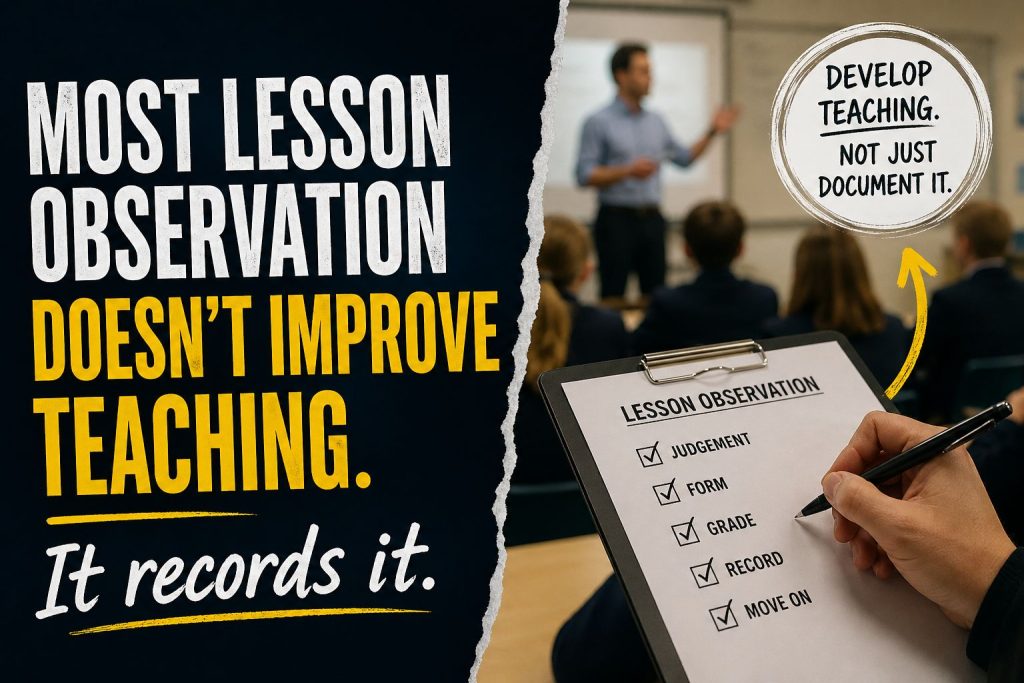
That’s the uncomfortable truth many leaders quietly recognise, even if the system around them doesn’t always allow them to say it out loud.
A familiar cycle plays out:
– A lesson is observed.
– A judgement is made.
– A form is completed.
– A grade is recorded.
– A short and sometimes defensive feedback conversation takes place.
And then… everyone moves on.
A teacher might be told their lesson is “good with outstanding features.” There might be a few notes on questioning or pacing. But six weeks later, in many cases, very little in their actual teaching has changed.
Not because teachers lack ambition or that leaders don’t care, but because the system is often designed to record performance, not develop practice.
Of course, there is a more developmental version of observation in many schools, where the focus is deliberately narrowed to one specific aspect of practice a teacher is working on, and tracked over time.
These coaching relationships can be powerful.
But in practice, it often fades. Follow-through becomes inconsistent. Coaching depth varies and the link between one observation and the next becomes unclear.
So even with good intent, the system quietly drifts.
And when it does, something subtle happens:
Teachers start to teach the observation, not the class. Leaders start to record the lesson, not develop the teacher. Ultimately, the process shifts from improvement to assurance.
Most leaders I speak to genuinely want developmental cultures in their schools. But the operational design of observation systems and the constraints on their time often pulls them back into cycles of judgement.
Which leads to a better question than the usual one. Instead of:
“How do we make lesson observation more rigorous?”
We should be asking:
“How do we make it actually improve teaching over time?”
The schools making real progress here are shifting the purpose entirely:
Judgement → Growth
Reporting → Development
It changes:
– what feedback is for
– what leaders pay attention to
– what actually improves in classrooms
We don’t need more lesson observation.
We need systems that actually develop teaching and AI is now able to bridge that gap!
About the author
Phillip Lupton is the Founder and CEO of Elm Education. He has worked as a teacher, school leader, government adviser, curriculum author, and international speaker on education and school improvement. He writes about teacher development, instructional coaching, AI in education, and school leadership.